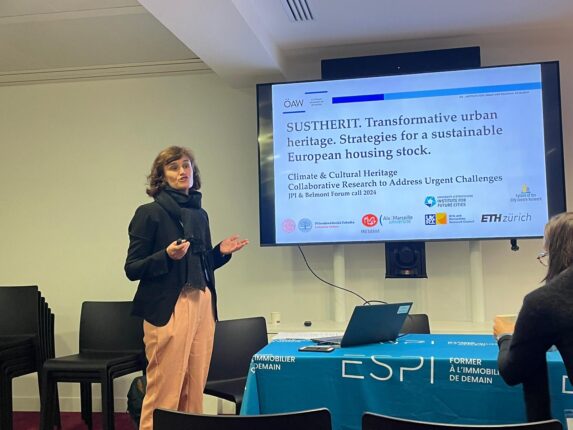
V. Lélek, 2024
ESPI International Real Estate Conference, Paris, 25-28 November 2024
SUSTHERIT project presentation by S. Guinand
The ESPI International Real Estate Conference (ESPI-IREC) is a bi-annual event run by ESPI2R. The 2024 event will be hosted in the core of Paris at rue Saint-Honoré, almost at the Louvre’s doors. The conference is to take place on site, without any online contribution nor live broadcast. The conference has grown into a premier platform for real estate researchers and experts from various disciplines such as – law, economics, management, finance, urban planning, architecture, and sociology – to engage in dialogue and to intertwine insights. Its primary aspiration is to nurture discussions on real estate transformations and mutations at all scales – global, regional, national and local – with a specific focus on the socio-territorial dynamics of housing and commerce premises, real estate markets and investors, and on issues revolving around property assets: its administration, management and use. In the scope of this conference, SUSTHERIT research project was presented.

S. Guinand, 2025
Rehabilitation of heritage in old centres.
Actors of the metropolitan fabric in times of climate emergency.
Bordeaux, 15 May 2025
Presentation "Structural Emergency and Climate Change: the Future of Marseille's Historic City Center in question" by
S. Belguidoum & M. Bergerand
The 11th study day of the ESPI Research in Real Estate (ESPI2r) laboratory offers the opportunity to exchange views between practitioners and researchers on an international scale. It initiates the discussion around several questions: what legal, technical and financial tools does the public authorities have at their disposal to support or even encourage the rehabilitation of the heritage inscribed by UNESCO? Which private actors are committed to this path? Who are the actors involved in the rehabilitation of the built heritage and what are their driving forces? Is the climate emergency a factor in accelerating rehabilitation or does it constitute a danger to the maintenance of old built heritage? Demolishing or renovating, safeguarding or renewing, what are the economic, social and heritage issues on which these trade-offs are based?

Belmont Forum, SRI, 2025
Sustainability Research and Innovation Congress, Chicago, 16-19 June 2025 SUSTHERIT project presentation by S. Belguidoum
SRI2025 spotlighted Pathways to Sustainability Solutions, sharing implementation strategies and legacies of successful approaches to critical sustainability concerns facing Chicago, the United States, and the globe. It also provided opportunities to overcome engagement, policy, resourcing, and other hurdles that slow our transformation to more resilient and equitable futures.

S. Belguidoum, 2025
EUGEO 8-11 September 2025, Vienna Session
Ordinary heritage in transformation. Developers´ interventions and private residential actions on historic housing stock.
Paper presentation by M. Bergerand "Heritage and spatial transformations : the case of Marseille’s historic city centre"
Over the last decade, historic housing has become the subject of investment by real estate developers, service companies and individual owners alike, resulting in a substantially modified function of this housing stock. The actions also disrupted the traditional configuration around local preservation policy by bringing new, often hard to control actors into the decision-making process of heritage preservation. A particular difficulty is presented in CEE cities, where the super-ownership tenure structure gives even less leeway for authorities. As a result, boundaries between the cultural, the political, and the market have become blurred, requiring critical attention to preservation and heritage constructs (Hafstein, 2012: 503) especially around ordinary historic objects, also reorienting their tangible and intangible significance.
In this context a proper assessment of these transformation and their outcomes is needed to balance private and public interest but also to see clearly the diverse economic and socio-cultural objectives. While issues of preservation and transformation of historic urban cores have been investigated and debated (Smith, 1998; McCabe, 2018), private actors´ intervention in historic housing stock, more specifically in ordinary historic housing objects, raise new questions around object selection, demolition and preservation processes.
Looking at historic residential buildings as “ordinary” heritage objects adheres to a heritage discourse that considers elements significant even when they are neither recognised by governments nor listed on official heritage registers but are considered significant or culturally meaningful by individuals, communities, and collectives for the ways in which they constitute themselves and operate in the present (Harrison, 2010). Taking this approach as a point of departure this session invites empirical and theoretical contributions that deal with these questions and issues. It is particularly interested in submissions dealing with new heritage expressions, place identity, social and technical innovations/responses, spatial transformation in the context of investments into the housing stock.
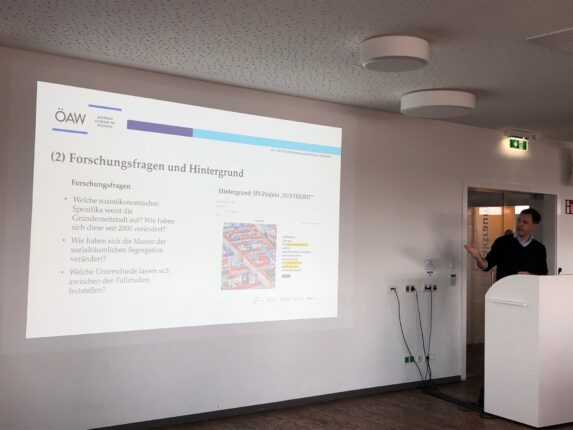
S. Guinand, 2026
Seminar on the Future of Housing, 26-27 February 2026, Vienna
Die europäische Gründerzeitstadt – ein Raum sozialer Diversität?
Sozialräumliche Muster und Segregationstendenzen in europäischen Metropolen (The European Gründerzeit city – a space of social diversity?
Spatial patterns and segregation tendencies in European metropolises)
Presentation by R. Musil, S.Guinand and D. Sümeghy
The Gründerzeit city encompasses the historical period of urban growth that is closely linked to industrialization and can be roughly dated in Europe—with considerable regional differences—between 1850 and World War I. Due to their strict block structure, representative facades, and lively ground floor zones, these historic urban structures are constitutive of architectural heritage and European urbanity. In addition, the European Gründerzeit city is characterized by a high degree of social variation, marked both by (upper) middle-class neighborhoods and by those dominated by socially disadvantaged households – so-called “working-class neighborhoods.” In many European cities, Gründerzeit neighborhoods are also the “Arrival City,” i.e., the city of arrival, which offers low-threshold access to housing, especially for immigrants.
This article examines how social variation in existing cities built during the Gründerzeit period has changed against the backdrop of the real estate price boom of the past 20 years. Has the increasing commodification of housing and rising real estate prices led to a change in socio-spatial patterns? Does the Gründerzeit city still have a specific social quality in terms of housing compared to the rest of the existing stock?
The article analyzes the socio-spatial structure of the existing Gründerzeit city for four selected European metropolises that are characterized by different regulatory contexts and real estate price dynamics: Glasgow, Marseille, Prague, and Vienna. Changes in the social structure and patterns of residential segregation in these cities are examined for the period from 2001 to 2021.
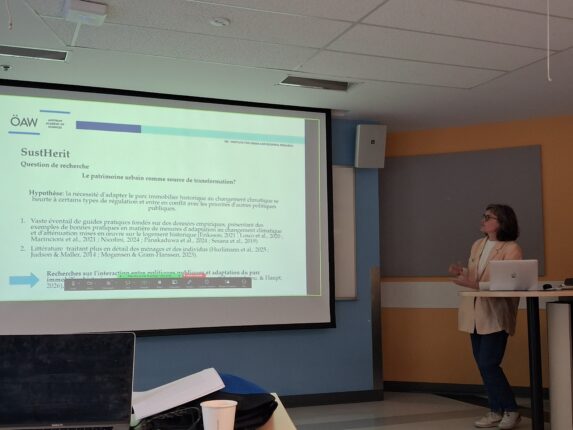
M. Boivin, 2026
Symposium on Heritage Entrepreneurs, 21-22 May 2026, Montreal (CA)
Le patrimoine urbain comme source de transformation? Stratégie pour un parc immobilier durable. Le cas de Vienne //
Urban heritage as a source of transformation? A strategy for a sustainable housing stock. The case of Vienna.
Presentation by Sandra Guinand, Ludek Sýkora, Richard Janeček, Jan Mýl
On the 22nd of May 2026, the Canada Research Chair in Urban Heritage organised a one-day symposium in Montreal entitled ‘Heritage Entrepreneurs’, bringing together researchers and specialists to discuss contemporary transformations in historic neighbourhoods and investment strategies in urban heritage. Held at the Président-Kennedy Pavilion at the Université du Québec à Montréal, the event brought together a range of international perspectives on property market dynamics, densification, the regeneration of historic centres and the challenges of sustainable development as they relate to urban heritage.
The symposium brought together researchers from Quebec and Europe to discuss topics such as the sustainable transformation of heritage cities, the regeneration of historic cities, and the role of private developers within heritage areas. The event formed part of the HerEnterp project and aimed to foster interdisciplinary dialogue on the future of historic neighbourhoods and models of sustainable urban development. More: https://l1nq.com/212yb9z
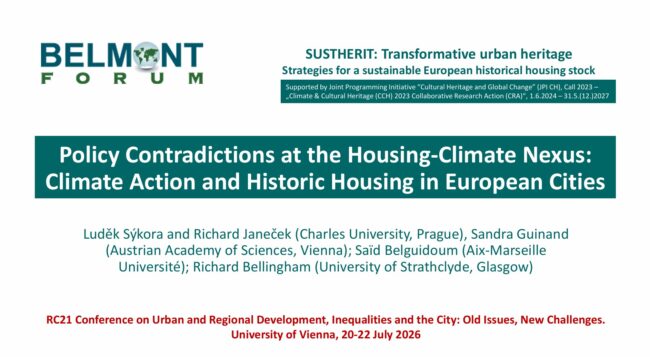
L. Sykora 2026
RC21 "Inequalities in the City. Old issues, New Challenges" 20-22 July 2026, Vienna
Special Session "The Housing–Climate Nexus: Conflicts, Controversies, and
Alternatives"
Policy Contradictions at the Housing–Climate Nexus: Climate
Action and Historic Housing in European Cities.
Presentation by Ludek Sýkora, Richard Janeček, Sandra Guinand, Said Belguidoum & Richard Bellingham
This paper analyses policy contradictions, conflicts, and unrealised synergies at the housing–climate nexus through the lens of climate action and historic housing stock protection in central and inner-city areas of Glasgow, Marseille, Prague, and Vienna. Drawing on a comparative analysis of city-, national-, and EU-level policies and regulations, complemented by interviews with key urban and housing actors, the study examines how climate action agendas interact with heritage protection frameworks and housing governance, generating persistent tensions between environmental objectives, cultural preservation, and social needs.
The paper addresses three interrelated research questions: (1) how climate action strategies frame and address historic housing stock and historic residential neighbourhoods; (2) which regulatory frameworks shape climate-related interventions in historic housing and how these are applied in practice; and (3) what conflicts, controversies, and potential synergies emerge from interactions between climate policies, heritage protection regimes, and the practices of actors involved in urban and housing development.
The analysis focuses on three dimensions. First, it examines tensions between heritage protection and climate action, where preserving the authenticity of historic housing often constrains energy retrofitting and other adaptation measures. Second, it explores how historic housing and its climate adaptation are positioned within broader urban development strategies, sustainability agendas, and housing provision. Third, it foregrounds social justice concerns, particularly housing affordability and social vulnerability, highlighting how climate and heritage policies can disproportionately affect residents of historic urban neighbourhoods.
The findings reveal persistent policy misalignments and governance conflicts that marginalise historic housing within climate action agendas, while heritage protection frameworks limit affordable renovation pathways. Rather than resolving housing–climate tensions, these dynamics reproduce contradictions between environmental goals, cultural values, and affordability, with uneven social impacts. The paper argues that addressing these conflicts requires greater attention to socially just and context-sensitive approaches to climate action in historic housing areas.