ISR-ÖAW
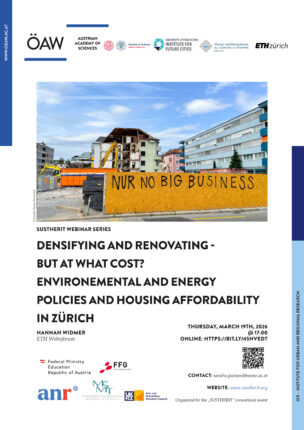
“Densifying and renovating – but at what cost? Environmental and energy policies and housing affordability in Zurich” Hannah Widmer- ETH Zürich
This talk will present insights from ongoing research in the framework of the ReHousIn project («Contextualised pathways to Reduce Housing Inequalities in the Green Transition»). Setting the scene by giving an overview of policies promoting densification and energy refurbishments in Switzerland, we will then focus on their implementation and their interlinkages with market dynamics in Zurich, specifically in Altstetten. This neighbourhood was officially designated as one of the priority areas for densification and has been undergoing profound transformations in recent years, which have increasingly been accompanied by detrimental consequences for the inhabitants of the renewed buildings.
Hannah Widmer is a postdoctoral researcher at ETH Wohnforum – ETH CASE in the Department of Architecture at ETH Zurich. As a sociologist and human geographer, her research focuses on the influence of environmental and energy policies on housing inequalities, regional effects of housing shortages, processes of inclusion and exclusion in public space.
ISR-ÖAW
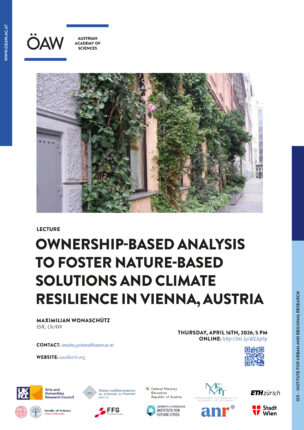
Ownership-based analysis to foster Nature-Based Solutions and climate resilience in Vienna, Austria - Maximilian Wonaschütz, ISR-ÖAW
“Who owns the city?” is one of the central questions in the early stages of planning any transformation of public space. This question becomes even more critical when implementing structural interventions such as Nature-Based Solutions (NBS). The knowledge of ownership structures plays a crucial role not only in terms of approval processes but also in addressing property owners as potential participants in such initiatives.
The PLOVGIS project aims to combine ownership data with open government data to analyze the potential for vertical greening in public space on a city-wide level. It seeks to identify both opportunities and limitations of this combined data by comparing it to actual publicly funded greening projects on private property. In doing so it also narrows down the role of the ownership structure in the context of urban climate adaptation strategies.
Maximilian Wonaschütz is a pre-doctoral researcher at the Institute for Urban and Regional Research of the Austrian Academy of Sciences. His work adopts a predominantly spatial-technological perspective, focusing on ownership structures within the built environment. In particular, he investigates their interrelations with the socio-demographic composition of neighborhoods, as well as the effects of an increasingly commodified housing market on patterns of property ownership.
ISR-ÖAW
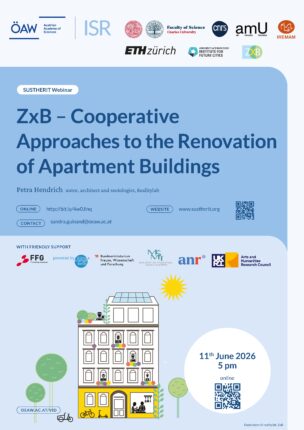
ZxB – Cooperative Approaches to the Renovation of Apartment Buildings - Petra Hendrich, realitylab
This presentation introduces “ZxB – Zinshaus X Baugruppe” an applied research project that aims at finding innovative approaches to urban renewal in which private historic building (Zinshaus) owners and co-housing groups collaborate to refurbish and adapt the building to new climate incentives. In the context of decarbonization, the project explores how cooperative renovation approaches can overcome the renovation standstill of historic housing stock. It highlights the specific challenges faced by owners as well as the potential of community-oriented user groups.
The focus is on legal and financial implementation models such as master leases (Generalmiete) or leasehold (Baurecht) which open up long-term prospects for historic buildings (Zinshäuser) and residents. Furthermore, a facilitated process for reaching a cooperation agreement creates the necessary foundation of trust for successful renovation. It is made clear that co-housing groups relieve private owners of burdens through their financial and organizational resources as well as by sharing responsibility for building operations. This creates an opportunity for residents to access affordable housing tailored to their needs in central urban locations.

ISR-ÖAW
Practices, stories and imaginaries of the Cour de la Cabucelle (Marseille) -Muriel Girard, ENSA Marseille/INAMA
This presentation outline aspects of a research project
based on fieldwork carried out in The Cabucelle neighbourhood
of Marseille. In this research, I have sought to examine heritage
practices through the lens of care — looking after others by
paying attention to people and things. By raising the question of
heritage, the aim was to ask: what do we hold dear? What do we
inherit and what do we pass on? Building on this research, I will
draw connections to examine a spatial feature – the courtyard –
as a space for social practices from a historical perspective –
through the example of worker priests and housing shared by
working-class communities; then the reappropriation of the
courtyard 50 years later by new residents who will turn it into
heritage in a post-industrial context; and finally, the imagery that architects and urban planners associate with it in contemporary urban regeneration projects. Online: http://tiny.cc/9zm6101